Where practical decisions are really made
Sustainability has been part of the conversation in TV and film for some time. Most people working in the industry understand why it matters. The challenge is not awareness, it’s how sustainability fits into the reality of production.
Budgets are tight. Schedules are compressed. Decisions are often made quickly and under pressure. In that environment, sustainability can feel like something that happens at the edges rather than something embedded in the process.
Across industry conversations led by the British Film Designers Guild, and at events such as Focus London, one message comes up repeatedly: the biggest impact rarely comes from one bold gesture. Meaningful sustainability decisions have to be made early, during pre-prep. By the time a build is underway, many of the biggest opportunities have already passed. Choices made in pre-prep about scale, approach, reuse, and logistics consistently have more impact than adjustments made later.
Many of the examples referenced in this blog come from the BFDG’s Planet Positive Award, which recognises and openly shares examples of sustainable practice across design, construction, and production workflows.

This is where choices are made, materials are handled, and consequences are set.
Doing less, earlier, and with more intent
By the time a set is being built, many of the most influential sustainability decisions have already been made.
Reducing impact in the art department is rarely about cutting corners. More often, it’s about clarity. Being clear about what needs to be built versus what can be implied, and designing sets to work harder rather than building more of them, can significantly reduce material use and waste.
A well-documented example of this approach can be seen on The Crown (series 6), where eight original built spaces were redressed and reworked into over one hundred distinct settings.
Over-construction is rarely intentional. It often comes from uncertainty. Late scripts, evolving shot lists, or a lack of early alignment between departments can all lead to building “just in case”.
That link between uncertainty and over-building was addressed directly in the BFDG podcast The Art of Sustainability. Production Designer Blair Barnette explained how early clarity around camera use can fundamentally change what gets built:
“I need to know what your shots are, what lenses are you using. Show me your storyboard of what you’re seeing, and I’m going to build that and only that.”
When those conversations happen early enough, sets can be designed precisely for what will be seen on camera. Across many Planet Positive projects, the biggest sustainability gains came not from different materials, but from committing early, limiting options, and avoiding late change. In that sense, sustainability is less a materials problem and more a planning one.
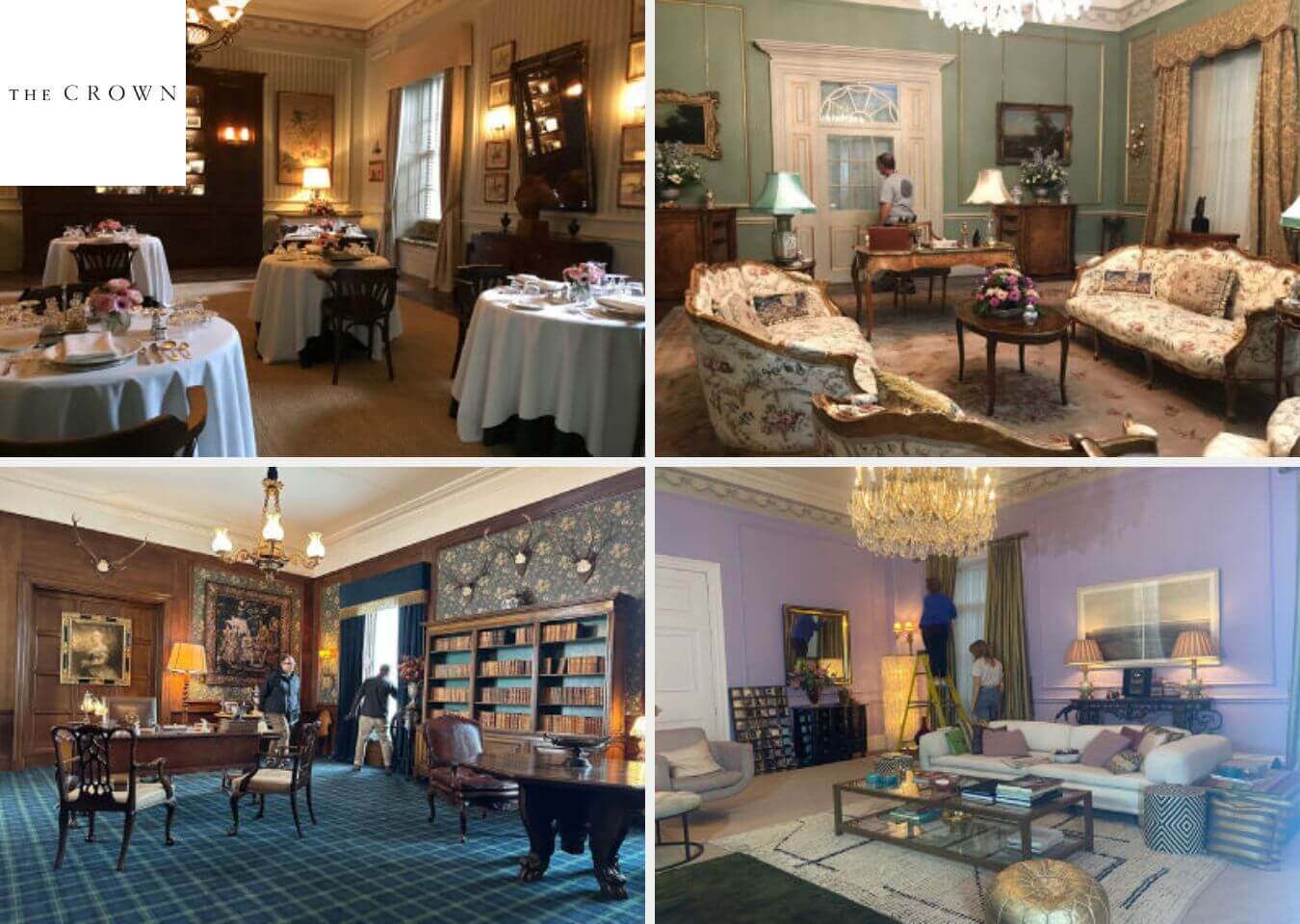
Multiple screen environments created from one composite Buckingham Palace set through repeated redressing and reworking.
Packaging: reducing waste you don’t see on screen
One area often overlooked in sustainability conversations is packaging.
Props and scenic elements move constantly between workshops, prop houses, locations, and studios. That movement usually comes with layers of single-use wrapping.
A practical alternative was presented by DELI – Delikatessen Props Collection Berlin OHG at an Artscenico talk on sustainable practice. DELI use padded, reusable covers designed specifically to protect props during transport and storage. The same covers are used repeatedly, reducing waste while still offering proper protection.
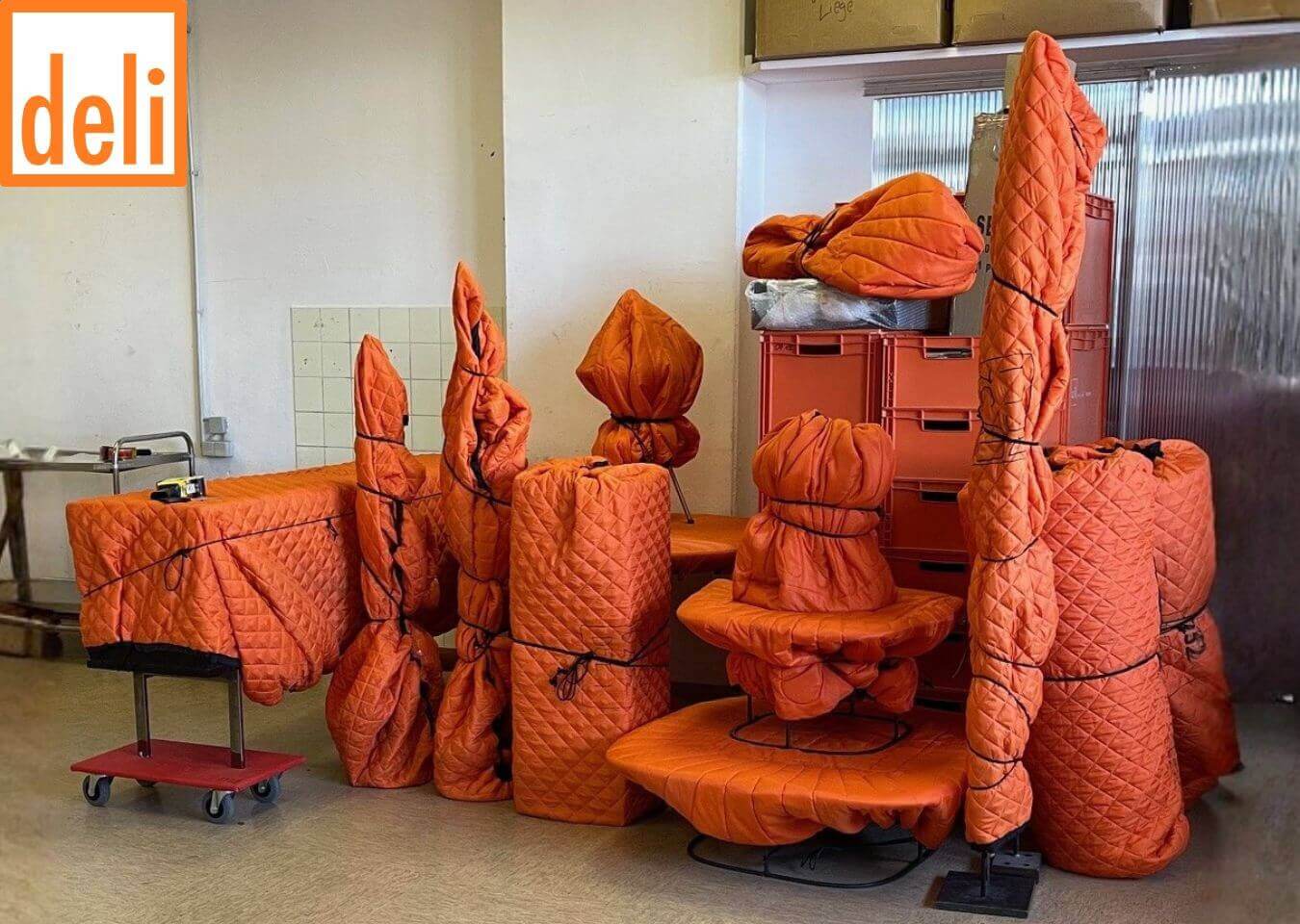
Reusable padded packaging used by DELI Prop Collection for transporting and storing props.
Reuse
Hiring, adapting, and planning for a second life
Reuse is the most visible part of sustainability, but it’s also where things most commonly fall apart.
As Production Designer Blair Barnette explained on the BFDG podcast The Art of Sustainability:
“Every prop that you buy, every choice that you make, you need to be thinking, at that moment, what its end of the line is. You can’t leave it to the very end.”
Wrap days are fast. Studios need clearing. Transport is booked. When reuse is left until the end, even well-made, usable materials can be lost simply because there is no space or system in place to deal with them properly.
This is where specialist organisations can make a real difference. PropUp Project, who spoke at Focus London about set and prop reuse, work directly with productions to collect and redistribute usable items to schools, community groups, and creative organisations. Their approach recognises the realities of wrap and provides a practical route for reuse when time and storage are limited.
Speaking about the wider value of reuse, PropUp notes:
“The materials we produce for entertainment have enormous value – where we can, we should be reusing within the industry, but if that’s not possible, we can have an impact far beyond the screen”

Materials redistributed through the PropUp Project to schools, community groups, and creative organisations following production wrap.
Similarly, Re-Set Scenery in Glasgow focuses on the reuse and redistribution of set materials, providing storage and a route for scenic elements to have a second life beyond a single production. These kinds of models rely on early conversations and coordination, but they demonstrate how reuse can function as part of a system rather than an afterthought.
Where reuse does break down, storage is often the limiting factor. Space costs money, workshops are finite, and expecting suppliers or productions to store large volumes of scenery indefinitely is not realistic, even when intentions are good.
Where storage does work is when conversations happen early enough to link projects together. Temporarily holding items because a next use has already been identified can save time, reduce material consumption, and lower overall cost.
In some cases, platforms such as Set-Exchange help make that next use visible early, allowing materials to be held briefly with a clear onward route rather than stored indefinitely or discarded at wrap.
A clear example of this approach at scale can be seen on EastEnders, where long-term storage and reuse are built into the way the show operates. Sets and scenic elements are routinely pulled from storage, adapted, and reworked rather than rebuilt from scratch. As the sole construction company working on the show, Totom works closely with the BBC to support this model, and has adopted the same ethos internally by storing reusable flats and hero props at our own warehouse so they can be brought back into use on future projects.
This isn’t something every production can replicate, but it shows what’s possible when reuse is considered from the outset and supported by the right infrastructure.
Recycle
Choosing materials with the end in mind
Recycling has an important role to play, but across many projects it tends to come into focus when reuse hasn’t been planned early enough.
Whether a set can be recycled easily or not is largely determined at the design and build stage. Material choice, fixings, and finishes all affect whether components can be separated and processed once a set comes down.
Cardboard and composite systems are one area where interest has grown. Their use on Good Omens 2, which received the BFDG Planet Positive Award, showed that alternative materials can deliver environmental benefits without compromising the on-screen result.
Reflecting on that project, Production Designer Michael Ralph said on the Planet Positive Award podcast:
“What the camera sees, and then how the audience feels, those are totally different things than what’s really there.”
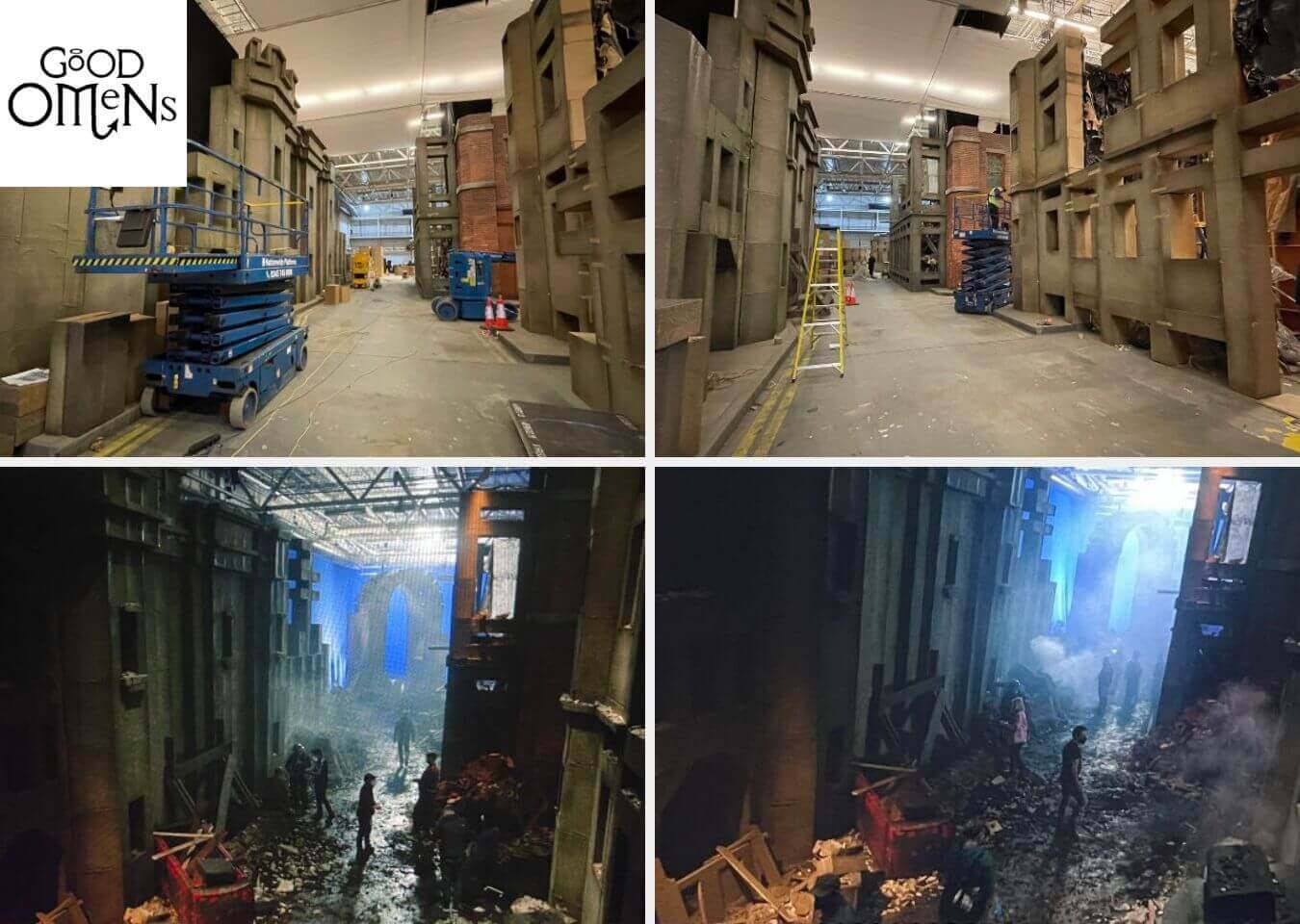
Good Omens 2. Cardboard-based set construction, designed with separation and recycling in mind.
Speaking about the role salvage plays in supporting lower-budget productions, Jem from Scenery Salvage explains:
“By helping low budget film, TV, video and theatre, we hope to encourage a generation of creatives who are more aware of their costs, both environmentally and financially.”
Beyond the screen industries, groups like Community Wood Recycling demonstrate how timber from a wide range of sources can be diverted from landfill and repurposed through local workshops, training programmes, and resale. While not film-specific, they highlight the importance of designing and breaking down sets in ways that allow materials to enter established recycling and reuse streams. On Man vs Baby, Totom worked with Riverside Timber Recycling, part of the Community Wood Recycling network, to remove usable timber from site for recycling and reuse, avoiding skips and landfill at strike.
Recycling works best when it’s considered as part of the build, not as a last step once a skip is already on its way.
Energy & Power
Where the biggest carbon impact really sits
Both the BFDG podcast The Art of Sustainability and the Focus London session Pathway to Fossil-Fuel-Free Film & TV were clear that the biggest carbon impacts on most productions come from transport and power.
As sustainability consultant Jimmy Keeping explained on the BFDG podcast:
“Fuel, whether that’s transport or power, typically makes up 40 to 70 percent of a production’s carbon footprint.”
While Production Designers do not control generators or fleet policy, design decisions still influence energy use. Decisions made early on, including whether a scene is built in a studio or shot on location, can have a knock-on effect on transport, power requirements, and material demand. Across multiple Planet Positive examples, reducing the number of builds and the number of moves consistently delivered greater carbon savings than swapping one material for another.
This is also where wider industry initiatives begin to matter. Projects such as Film London’s Grid Project, which aims to connect productions to existing electrical grid infrastructure and reduce reliance on diesel generators, show how systemic change can support lower-carbon production. These kinds of initiatives sit outside the art department, but their effectiveness is closely linked to early planning, coordination, and realistic scheduling decisions.
Energy reduction at scale depends less on individual product choices and more on aligning design, logistics, and infrastructure early enough for alternatives to be viable.
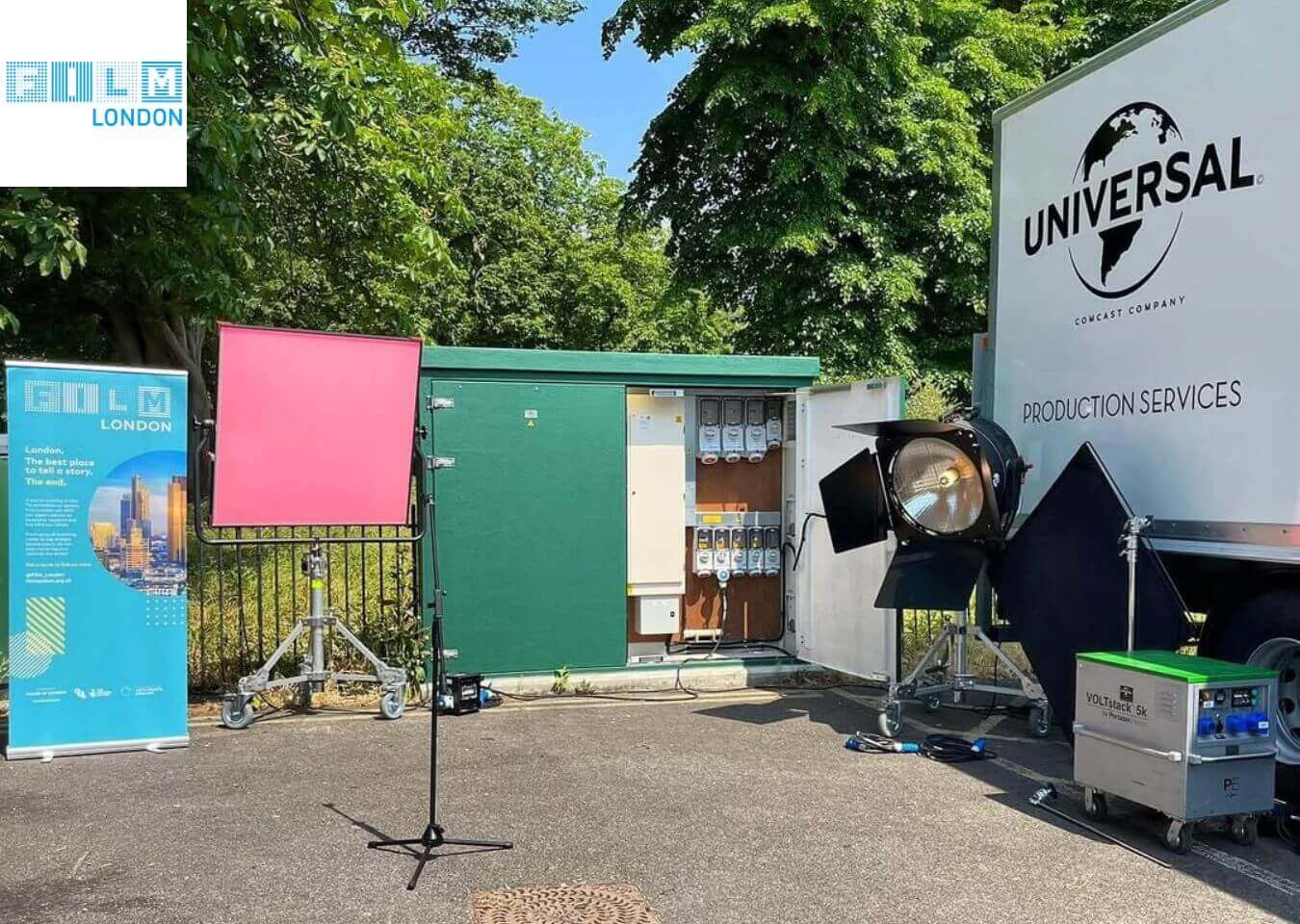
Grid-powered energy supply installed in London’s Victoria Park as part of Film London’s Grid Project pilot, testing alternatives to diesel generators on location.
Practical resources for designers
Many of the examples referenced in this blog come from the British Film Designers Guild and its Planet Positive Award. Each entry includes a publicly available document outlining what was done, what worked, and what didn’t, making it a valuable starting point for designers looking to explore sustainable practice in context.
Alongside this, many UK productions also work within the framework provided by ALBERT, which supports film and television productions in measuring and reducing their environmental impact. While ALBERT does not dictate creative decisions, its tools help make the carbon implications of transport, power, and build choices more visible across a production. We’ve also set out how ALBERT considerations are reflected in our construction processes in our sustainability policy, for those who want to see a supplier-side example in context.
Beyond formal industry organisations, Planet Positive case studies also highlight reuse through charities, charity shops, community groups, and local businesses. In several instances, materials, props, or surplus supplies were redistributed locally in response to specific needs, creating social benefit alongside environmental gain.
Some of these examples go beyond familiar routes of donation. On The Essex Serpent, surplus frozen fish originally sourced as props were donated to South Essex Wildlife Hospital, where they were used to feed an injured seal during rehabilitation. While highly specific, examples like this reflect a broader pattern: reuse is often most effective when teams are willing to think laterally and respond to local needs.
These outcomes were rarely accidental. They were the result of early conversations and clear responsibility, allowing items to be identified and passed on before time pressures at wrap made reuse impossible.
For designers looking to take practical steps, the most effective place to begin is often through industry bodies, events, and peer networks, where approaches can be discussed early and adapted to the realities of each production.
In addition to the organisations referenced above, freelance Production Buyer Mairi Claire Bowser has developed a series of free, UK-wide resource maps to support practical sustainability across film and television.
These include:
- Material Redistribution Map
- Natural, Historic, Alternative & Sustainable Building & Renovation Resource Map
- Sustainability in the UK Film & TV Industries Resource Map
- Accessibility in the UK & Ireland Film & TV Industries Resource Map
These publicly accessible tools help productions identify routes for material reuse, responsible sourcing, accessibility support and wider sustainable practice.
To find out more about our work, contact us:
email us at info@totom.co.uk,
or call on 01494 437 456
by Totom